

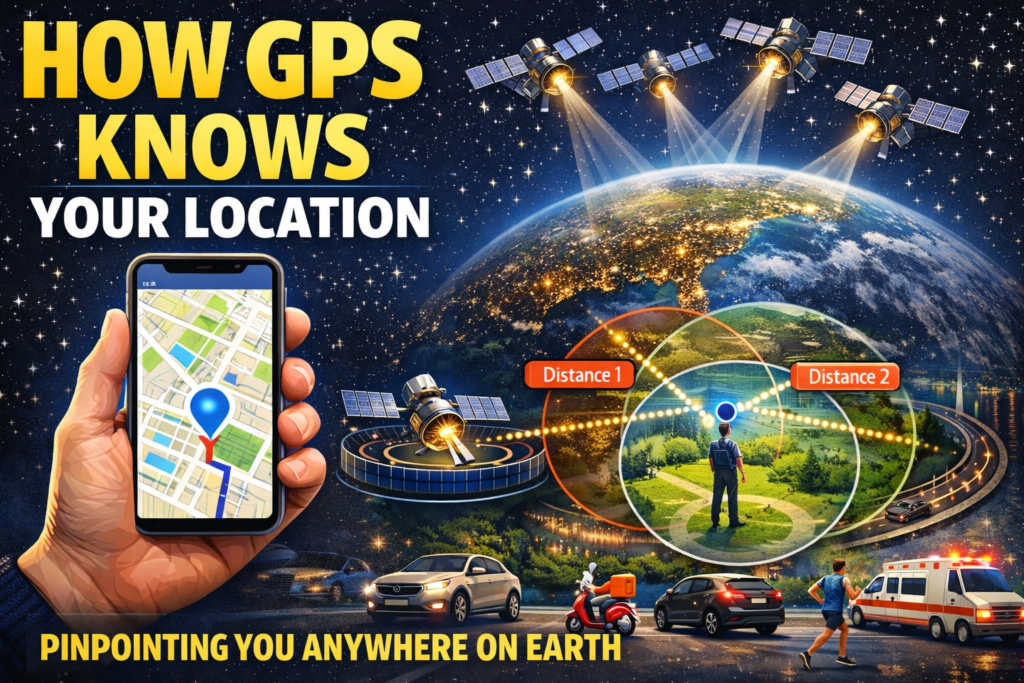
You’re running late for a meeting in an unfamiliar part of town. You pull out your phone, open Google Maps, and within seconds, a blue dot appears on the screen showing exactly where you are. You start walking, and the dot moves with you in real-time, guiding you turn by turn to your destination.
It feels like magic, doesn’t it? But here’s the wild part: there’s no camera watching you, no tracker embedded in the sidewalk. So how does your phone know exactly where you stand on this planet?
The answer is GPS—and the way it works is actually more fascinating than you might think.
What Is GPS?
GPS stands for Global Positioning System. Think of it as an invisible grid covering the entire Earth that helps your device figure out your precise location anywhere on the planet—whether you’re hiking in the mountains, driving through a city, or sitting in your backyard.
Originally built by the U.S. military in the 1970s, GPS became available for everyone to use in the 1980s. Today, it’s the backbone of countless apps and services we use daily, from ride-sharing to food delivery to fitness trackers.
GPS Satellites: Your Invisible Helpers in Space
Here’s where things get interesting. GPS doesn’t rely on cell towers or Wi-Fi. Instead, it uses a network of satellites orbiting Earth.
Right now, there are about 31 GPS satellites circling our planet at roughly 12,500 miles above the surface. They’re constantly moving, traveling at about 8,700 miles per hour, completing two full orbits every day.
Why satellites? Because they have an unobstructed view of Earth. Unlike cell towers that only cover specific areas, satellites can beam signals across vast distances. No matter where you are—desert, ocean, or mountaintop—at least four satellites can “see” you at any given moment.
Each satellite continuously broadcasts a simple message: “I am satellite #7, and I sent this signal at exactly 10:23:45.372 AM.”
That’s it. But that simple message is the key to everything.
How GPS Calculates Your Location: The Distance Circle Trick
Imagine you’re lost in a huge park, and you ask a friend for help finding you. Your friend says, “I can hear your voice, and based on how loud it is, you’re about 100 meters away from me.”
That’s helpful, but it doesn’t pinpoint your location—you could be anywhere on a circle with a 100-meter radius around your friend. You could be north, south, east, west, or anywhere in between.
Now imagine a second friend calls out, “I hear you too—you’re 150 meters from me!” Suddenly, you can narrow it down. You must be at one of the two spots where those two circles intersect.
Add a third friend who says, “You’re 80 meters from me,” and boom—there’s only one spot where all three circles meet. That’s where you are.
This is exactly how GPS works. It’s called trilateration.
Your phone receives signals from multiple satellites. Each signal tells your phone how far away that satellite is (based on how long the signal took to travel). With distance measurements from at least three satellites, your phone can calculate your position on Earth’s surface.
But there’s a catch.
Why You Need Four Satellites (Not Just Three)
In perfect conditions, three satellites would be enough to find your location in two dimensions—latitude and longitude. But we live in a three-dimensional world.
The fourth satellite does two crucial things:
- Adds altitude data – It tells you how high above sea level you are, which matters for hiking, flying, or even just being on different floors of a building.
- Corrects timing errors – Your phone doesn’t have a perfect clock. Satellites do (more on that in a second). The fourth satellite helps eliminate timing mistakes, ensuring your location is accurate.
The Secret Ingredient: Atomic Clocks and Split-Second Timing
Here’s the mind-blowing part: GPS signals travel at the speed of light—about 186,000 miles per second. Your phone calculates distance by measuring how long a signal takes to arrive.
But even a tiny timing error creates huge location mistakes. If your phone’s clock is off by just one-thousandth of a second, your calculated position could be wrong by 186 miles.
That’s why every GPS satellite carries atomic clocks—the most precise timekeeping devices ever made, accurate to within a few billionths of a second. Your phone’s internal clock isn’t nearly that good, but by comparing signals from four satellites, it can correct its own timing and still get your location accurate to within a few meters.
Why GPS Isn’t Always Perfect
Ever notice your location dot jumping around, or GPS losing you in a tunnel? Here’s why:
Tall buildings create “urban canyons” – Signals bounce off skyscrapers, creating false distances. Your phone might think a satellite is farther away than it really is.
Tunnels and indoor spaces block signals – GPS signals are weak and can’t penetrate thick concrete or underground areas well.
Weather and atmosphere – Heavy clouds, storms, or charged particles in the atmosphere can slow down GPS signals slightly, affecting accuracy.
Your phone’s quality matters – A cheap phone with a basic GPS chip won’t be as accurate as a high-end device with advanced sensors.
GPS in Everyday Life
GPS quietly powers more of your day than you realize:
- Navigation apps guide you through traffic and find the fastest routes
- Food delivery services know exactly when your order will arrive
- Ride-sharing apps connect drivers and passengers seamlessly
- Fitness trackers map your runs and calculate distance
- Airlines navigate planes across continents with precision
- Emergency services locate 911 callers, potentially saving lives
The Future of GPS and Navigation
GPS technology keeps getting better. New satellite systems like Europe’s Galileo and improvements to GPS itself are making signals more accurate and harder to jam. AI and machine learning help fill in gaps when satellite signals are weak, like inside buildings.
We’re moving toward a future with centimeter-level accuracy and seamless indoor navigation—imagine never getting lost in a massive airport or shopping mall again.
Conclusion
The next time that blue dot appears on your map, take a moment to appreciate the incredible dance happening above your head. Satellites thousands of miles away are sending perfectly timed signals, your phone is doing complex calculations in milliseconds, and all of it combines to tell you one simple thing: you are here.
It’s a reminder that some of the most powerful technology in our lives is completely invisible—silently working in the background, guiding us through our days, one precise location at a time.