

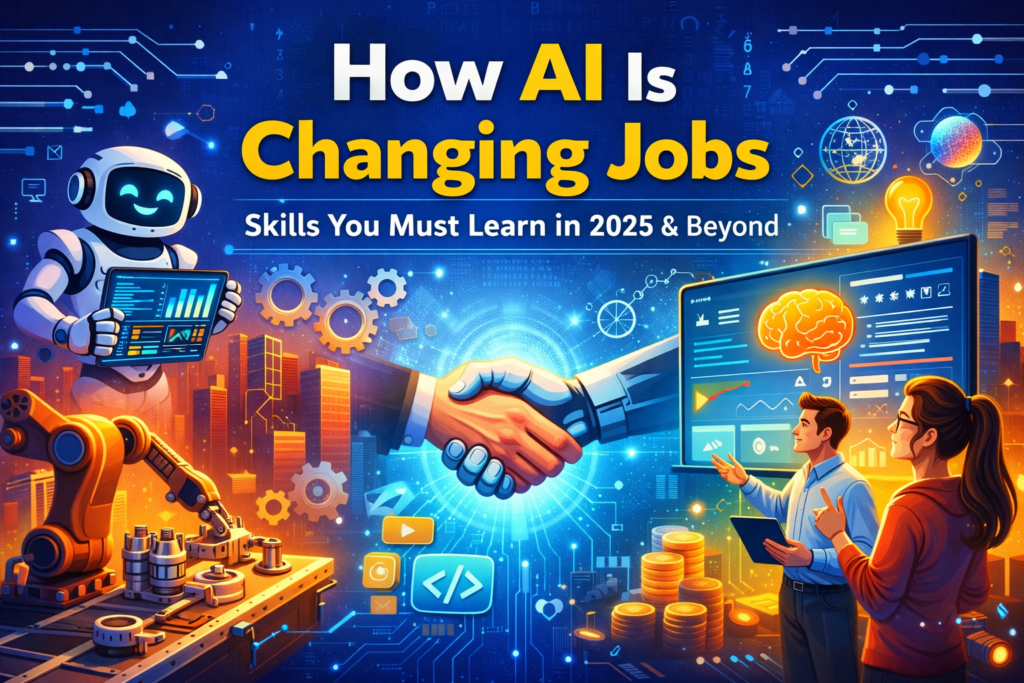
Introduction: The Future of Work Is Already Here
If you’re a student preparing for your first job, a fresh graduate entering the workforce, or a professional wondering if your career is safe—this article is for you.
Artificial Intelligence isn’t just a buzzword anymore. It’s actively reshaping how we work, what skills employers value, and which careers will thrive in the coming years. From chatbots writing emails to AI tools designing websites, the transformation is happening faster than most of us expected.
Here’s the truth: ignoring AI won’t make it go away. But learning to work with AI can turn it into your biggest career advantage.
The good news? You don’t need to become a programmer or data scientist to stay relevant. This guide will show you exactly which skills matter most in 2025 and beyond—and how you can start learning them today, even if you’re a complete beginner.
How AI Is Changing Jobs: What’s Really Happening
Jobs Being Automated
AI is taking over repetitive, rule-based tasks across industries. Here’s what’s changing:
- Data entry clerks – AI can process and organize data faster and with fewer errors
- Basic customer support roles – Chatbots handle common queries 24/7
- Simple bookkeeping tasks – Automated software tracks expenses and generates reports
- Assembly line workers – Robots perform repetitive manufacturing tasks
- Basic content moderation – AI scans and flags inappropriate content
But here’s what most headlines miss: entire jobs aren’t disappearing overnight. Instead, specific tasks within jobs are being automated.
Jobs That Are Evolving (Not Disappearing)
Most careers aren’t being replaced—they’re being transformed. Professionals now work alongside AI:
- Accountants use AI to automate calculations but still provide strategic financial advice
- Graphic designers use AI tools like Midjourney for inspiration, then add creative direction
- Teachers use AI to personalize learning materials while focusing on mentorship
- Doctors rely on AI for faster diagnosis but make final treatment decisions
- Writers use AI for research and drafts, then edit with human insight and emotion
Real example: Marketing teams that once spent hours on competitor analysis now use AI tools to gather data in minutes—freeing them up for creative strategy and relationship building.
New Jobs Created by AI
Every technological shift creates new opportunities. AI is no different:
- Prompt engineers – Specialists who write effective instructions for AI tools (salaries starting at $80,000+)
- AI trainers – People who teach AI systems to understand context and nuance
- AI ethics consultants – Professionals ensuring AI is used responsibly
- Automation specialists – Experts who help companies integrate AI into workflows
- AI content strategists – Marketers who blend human creativity with AI efficiency
Real-world example: A 2024 LinkedIn report showed a 300% increase in job postings requiring “prompt engineering” skills compared to 2023.
Industries Most Affected by AI
IT & Software Development
Developers now use AI coding assistants like GitHub Copilot to write code faster. The shift isn’t about replacing programmers—it’s about making them more productive. Junior developers must now learn to review AI-generated code critically rather than writing everything from scratch.
Marketing & Content Creation
AI writes product descriptions, generates social media captions, and creates basic graphics. But marketers who understand brand voice, audience psychology, and strategic storytelling remain irreplaceable. The skill gap is closing between those who use AI as a tool and those who fear it.
Engineering & Manufacturing
Smart factories use AI to predict equipment failures before they happen. Engineers who understand both mechanical systems and data analysis are in high demand. Traditional engineering roles now require basic programming and data literacy.
Finance & Accounting
AI handles invoice processing, fraud detection, and basic financial forecasting. Accountants who can interpret AI insights and provide strategic business advice command premium salaries. The profession is shifting from number-crunching to advisory roles.
Healthcare
AI assists in reading X-rays, predicting patient risks, and managing hospital operations. However, doctors and nurses who combine medical expertise with empathy and critical decision-making remain essential. Healthcare workers learning to interpret AI recommendations are advancing faster in their careers.
Education
AI tutors provide personalized learning, but teachers who mentor, motivate, and develop critical thinking skills are more valuable than ever. Educators using AI to handle grading and administrative tasks report more time for meaningful student interaction.
Skills You Must Learn to Stay Relevant
AI Literacy & Prompt Engineering
What it means: Understanding how AI works and knowing how to communicate effectively with AI tools.
You don’t need to build AI—you need to use it well. Learning to write clear, specific prompts for ChatGPT, Gemini, or Copilot can make you 10x more productive.
Start here: Spend 15 minutes daily experimenting with different AI tools. Practice asking better questions and refining your prompts.
Data Analysis & Critical Thinking
Why it matters: AI generates insights, but humans must decide what actions to take.
Basic understanding of data interpretation, spreadsheets, and analytical thinking sets you apart. Employers value people who can look at numbers and spot patterns or problems.
Practical step: Learn Google Sheets or Excel formulas. Practice analyzing simple datasets from your daily life (budgets, fitness tracking, etc.).
Programming Basics (Python & Automation)
The reality: You don’t need to be a software engineer, but knowing basic programming opens doors.
Python is beginner-friendly and useful across industries—from automating boring tasks to analyzing data. Even non-technical professionals benefit from understanding simple automation.
Getting started: Complete a free 30-day Python basics course. Focus on practical applications like automating email responses or organizing files.
Creativity & Problem-Solving
Here’s the truth: AI can generate ideas, but it can’t think originally or solve complex human problems.
Creative thinking, innovation, and the ability to approach challenges from unique angles remain uniquely human skills. Employers desperately need people who can do more than follow AI suggestions.
Build this skill: Practice brainstorming without AI first. Work on side projects that require original thinking. Join creative communities.
Communication & Collaboration
Why it’s critical: As AI handles technical tasks, human skills like clear communication, teamwork, and emotional intelligence become more valuable.
Being able to explain complex ideas simply, work across teams, and build relationships matters more in an AI-powered workplace.
How to improve: Practice writing clearly. Join group projects. Learn to give and receive feedback constructively.
Digital Marketing & Tech Tools
The opportunity: Every business needs digital presence, and AI is transforming marketing.
Understanding SEO, social media algorithms, email marketing, and AI-powered marketing tools makes you valuable in any industry.
Quick win: Learn one new digital tool each month. Master Google Analytics basics, try email marketing platforms, experiment with social media scheduling tools.
Adaptability & Continuous Learning
The most important skill: The willingness to keep learning as technology evolves.
Professionals who embrace change and continuously update their knowledge will always find opportunities. Those who resist learning new tools will struggle.
Make it a habit: Dedicate 30 minutes daily to learning. Follow industry leaders. Stay curious about emerging technologies.
Technical vs Non-Technical Skills: What You Really Need
| Technical Skills | Non-Technical Skills |
|---|---|
| AI & prompt engineering | Critical thinking |
| Basic programming (Python) | Creativity & innovation |
| Data analysis tools | Communication skills |
| Automation software | Emotional intelligence |
| Digital marketing platforms | Adaptability |
| Best for: Tech roles, data analysts, developers | Best for: Management, creative roles, client-facing positions |
For non-tech students: Focus first on AI literacy, data basics, and one practical technical skill (like Excel automation or digital marketing tools). Then build strong communication and problem-solving abilities. This combination makes you valuable across industries.
How Students & Professionals Can Start Learning These Skills
Free & Paid Learning Platforms
Free resources:
- Coursera – AI for Everyone (beginner-friendly course by Andrew Ng)
- Google’s AI Essentials – Free certification program
- YouTube – Channels like freeCodeCamp, Andrej Karpathy for programming
- ChatGPT/Claude – Practice prompt engineering directly with AI tools
Paid options (worth the investment):
- Udemy – Affordable courses on Python, data analysis, digital marketing ($10-20 during sales)
- LinkedIn Learning – Professional skill development with certificates
- DataCamp – Hands-on data science and analytics training
Daily Learning Roadmap (30-60 Minutes Per Day)
Morning (15 minutes): Read one article about AI trends or watch a tutorial video
Afternoon (20 minutes): Practice one skill—write prompts, solve a Python problem, or analyze a dataset
Evening (15 minutes): Work on a small project or join an online community discussion
Weekend (2-3 hours): Build something practical using your new skills
Practical Project Ideas
- Automate your daily tasks – Create a Python script to organize files or send reminders
- Build an AI-powered content calendar – Use ChatGPT to plan social media posts, then refine them
- Analyze personal data – Track your expenses or habits and create visualizations
- Create a portfolio website – Use AI tools to help design, but add your unique content
- Start a learning blog – Document your AI learning journey and build communication skills
Common Myths About AI & Jobs
Myth 1: “AI Will Replace All Jobs”
Reality: AI replaces tasks, not entire jobs. Most roles will evolve to work alongside AI. Historical precedent shows technology creates more jobs than it eliminates—the jobs just look different.
Myth 2: “Only Programmers Need to Worry”
Truth: AI affects everyone—marketers, designers, accountants, teachers, and more. But it affects people who don’t learn to use AI much more than those who do. Every profession needs AI-literate workers.
Myth 3: “AI Skills Are Too Hard to Learn”
Fact: Basic AI literacy and prompt engineering are easier than learning Excel was 20 years ago. You don’t need a computer science degree. Start with user-friendly tools and build gradually. Many successful AI professionals started with zero technical background.
Conclusion: Your Future Is in Your Hands
The question isn’t whether AI will change your career—it already is. The real question is: Will you lead the change or be left behind?
Here’s the empowering truth: You have time to prepare. AI is creating more opportunities than it’s eliminating, especially for those willing to learn and adapt.
Start small today. Pick one skill from this guide. Spend 30 minutes learning. Then do it again tomorrow.
The future belongs to professionals who combine human creativity, critical thinking, and emotional intelligence with AI capabilities. That person can be you.
Your action plan: Choose one AI tool to master this week. Complete one free course this month. Build one small project this quarter. Your career will thank you.
FAQ: AI and Future Jobs
Q1: Which jobs are safest from AI automation?
Jobs requiring creativity, complex problem-solving, emotional intelligence, and human interaction are safest. This includes therapists, creative directors, strategic consultants, teachers, and healthcare professionals who combine technical knowledge with human empathy.
Q2: Do I need a degree in computer science to work with AI?
No. While technical degrees help, many AI-related roles value practical skills over formal education. Focus on building a portfolio of projects and demonstrating your ability to use AI tools effectively.
Q3: How long does it take to learn AI skills?
Basic AI literacy and prompt engineering: 2-4 weeks. Practical programming for automation: 3-6 months. Advanced data analysis or AI development: 12+ months. The key is starting now and learning consistently.
Q4: Will AI make salaries go down?
Not for skilled workers. Professionals who combine AI expertise with domain knowledge often command higher salaries. The gap is widening between those who use AI effectively and those who don’t.
Q5: What’s the single most important skill for future careers?
Adaptability and continuous learning. Technology will keep evolving, but people who embrace change and keep updating their skills will always find opportunities.
Q6: Are there jobs AI will create that don’t exist yet?
Absolutely. Just as “social media manager” didn’t exist 20 years ago, new roles will emerge. Focus on foundational skills—critical thinking, communication, technical literacy—that transfer to any future job.
Q7: Should I be worried about AI taking my current job?
Instead of worrying, take action. Identify which parts of your job AI could automate, then develop skills in areas AI can’t replicate. Most jobs will transform rather than disappear—but only for those who adapt.